


What is Agentic Shopping? The Technology, The Creators, Rollout Timelines, and What People Are Actually Buying
For thirty years, e-commerce has operated on a single, repetitive interaction model: humans open a browser, type keywords into a search bar, scroll past sponsored ads, click through product pages, compare prices across five open tabs, and manually key in shipping addresses and payment details. That model is rapidly becoming obsolete.
The successor is Agentic Shopping—an architectural leap where autonomous AI software agents discover, evaluate, negotiate, bundle, and execute transactions on behalf of consumers and businesses. Instead of browsing a digital storefront, users assign high-level goals: "Restock our household pantry with certified organic oat milk and high-absorbency paper towels when remaining stock hits 3 days, ensuring total landed cost beats S$45." Here is an exhaustive breakdown of the underlying technology, the tech giants building it, the global rollout schedule, the growing pains encountered so far, and what consumers are actually buying with agents in 2026.

Figure 1: Autonomous shopping agents evaluate product specs, compare landed prices across merchants, and prepare optimized checkout baskets without manual search fatigue.
🧠 What Exactly Is Agentic Shopping?
At its core, agentic shopping represents the transition from conversational search to delegated execution:
- GenAI 1.0 (Information Retrieval): You ask an AI model, *"What are the best running shoes for marathon training with high arch support?"* The AI outputs a bulleted list of 5 shoes with descriptions. You still have to click links, check store inventory, select sizes, and complete checkout manually.
- Agentic Shopping (Autonomous Execution): You state, *"Find my standard running shoe in US Men's 10.5, cross-reference inventory across authorized local and international distributors, apply my verified loyalty credentials, verify shipping delivery within 5 business days, and stage the cart for my 1-click confirmation."* The agent queries live APIs, locks in the inventory, verifies the return policy, and queues the payment token.
⚙️ The Underlying Tech: How Does It Actually Work?
Agentic commerce is not a single app; it is a stack of interoperable protocols and machine-to-machine standards operating quietly beneath the user interface:
1. Universal Cart Protocol (UCP) & Agent-to-Payments (AP2)
Previously, an online cart belonged strictly to a single merchant's domain. UCP provides an open abstraction layer allowing an agent to assemble a consolidated shopping basket containing items from separate, disparate merchant backends (e.g. coffee beans from a boutique roaster, milk from a local dairy, and sports recovery plasters from a medical supplier) and settle them through a unified transaction stream.
2. Model Context Protocol (MCP) & Headless Tool Interfaces
Rather than scraping HTML pages like fragile web bots of the past, AI agents communicate directly with merchant databases via standardized tool endpoints. Under MCP, an online store exposes clean, low-latency tools: check_stock(sku), calculate_landed_shipping(postal_code), and reserve_cart(items). This eliminates scraping errors and ensures 100% price integrity.
3. Structured Semantic JSON-LD Schemas
Agents do not look at flashy hero banners or lifestyle photos; they ingest structured metadata. Retailers who format their catalogs with Schema.org specifications (explicitly detailing priceCurrency, unitCode, dimensions, weight, and inventoryLevel) rank highest in agent retrieval algorithms.
🏛️ Who Created It? The Key Ecosystem Architects
Agentic commerce is the result of parallel convergence across four foundational infrastructure tiers:
- Google: Pioneered the foundational schemas of Merchant Center feeds, the open Universal Cart Protocol extensions, and Gemini-powered automated checkout integrations directly within Google Search and Chrome.
- OpenAI: Accelerated agentic tooling with multimodal vision and the "Operator" autonomous browsing framework, enabling agents to navigate complex legacy checkout flows that lack native APIs.
- Shopify: The commerce backbone. Shopify rolled out native Storefront Agent APIs and headless checkout primitives, ensuring millions of independent merchants are instantly discoverable and transactable by AI agents without writing custom code.
- Anthropic: Standardized developer integration through the open-source Model Context Protocol (MCP) and Computer Use API, establishing the universal language for connecting AI models to commercial databases.
- Airwallex: The modern financial rail. Providing programmatic virtual commercial cards, scoped spend limits, and multi-currency global settlement, allowing agents to transact securely without exposing primary corporate or personal credit accounts.

Figure 2: The "Human-in-the-Loop" standard: agents perform 99% of the computational legwork, requiring a single biometric touchpoint before funds are settled.
📅 The Global Rollout Timeline: When Is It Hitting Singapore?
| Phase & Window | Target Geography | Core Capabilities Unlocked | Consumer Adoption Stage |
|---|---|---|---|
| Phase 1 (2024 – Early 2025) | United States (Pilot) | Developer sandboxes, closed grocery trials (Instacart, Walmart), price alerts. | Early Tech Pioneers |
| Phase 2 (Late 2025 – 2026) | North America & UK | Native browser checkouts (Chrome, Safari), travel itinerary bundling, repeat pantry restocking. | Mainstream Early Majority |
| Phase 3 (Mid 2026 – 2027) | Singapore, Australia & East Asia | Cross-border multi-currency settlement, Singpass-authenticated age/medical checks, neighborhood milk-run fulfillment. | High-Density Citywide Scale |
Singapore is primed to be one of the world's most aggressive adopters during Phase 3. With near-universal mobile wallet penetration, compact urban delivery radiuses, and statutory digital identity infrastructure, local supermarkets, pharmacies, and sports suppliers can fulfill agent-coordinated neighborhood deliveries in under 4 hours.
📈 How It’s Been Going So Far: Real-World Lessons & "Rogue Agents"
The rollout of agentic commerce has not been without growing pains. Early deployments highlighted three distinct friction points that forced developers to institute strict safety guardrails:
1. The "Dollhouse" Miniature Edge Case
In early 2025 test cohorts, unconstrained agents instructed to buy "the lowest priced 12-pack of paper towels" purchased dollhouse miniature scale models instead of actual grocery items.
Because the agent optimized purely for lowest price across keywords, it lacked physical dimension awareness. This resulted in mandatory dimensional schemas (requiring length, width, and pieceCount) across all verified merchant feeds.
2. Volumetric Shipping Shocks
Early consumer agents ordered bulky items from three separate merchants without calculating combined freight. A consumer who thought they saved S$4 on laundry detergent was billed S$22 across three separate courier dispatches. Modern protocols now calculate total landed cost (inclusive of parcel cubic fees) before executing checkout.
3. The Industry Standard: Human-in-the-Loop (HITL) 1-Click Biometric Lock
To completely eliminate "rogue agent" runaway purchases, the global e-commerce industry converged on the Human-in-the-Loop architecture. The agent performs 99% of the computational heavy lifting—finding inventory, verifying specs, bundling for free shipping thresholds, and filling out billing tokens. However, the transaction remains paused until the user receives a push notification and confirms the order with FaceID or fingerprint biometrics.
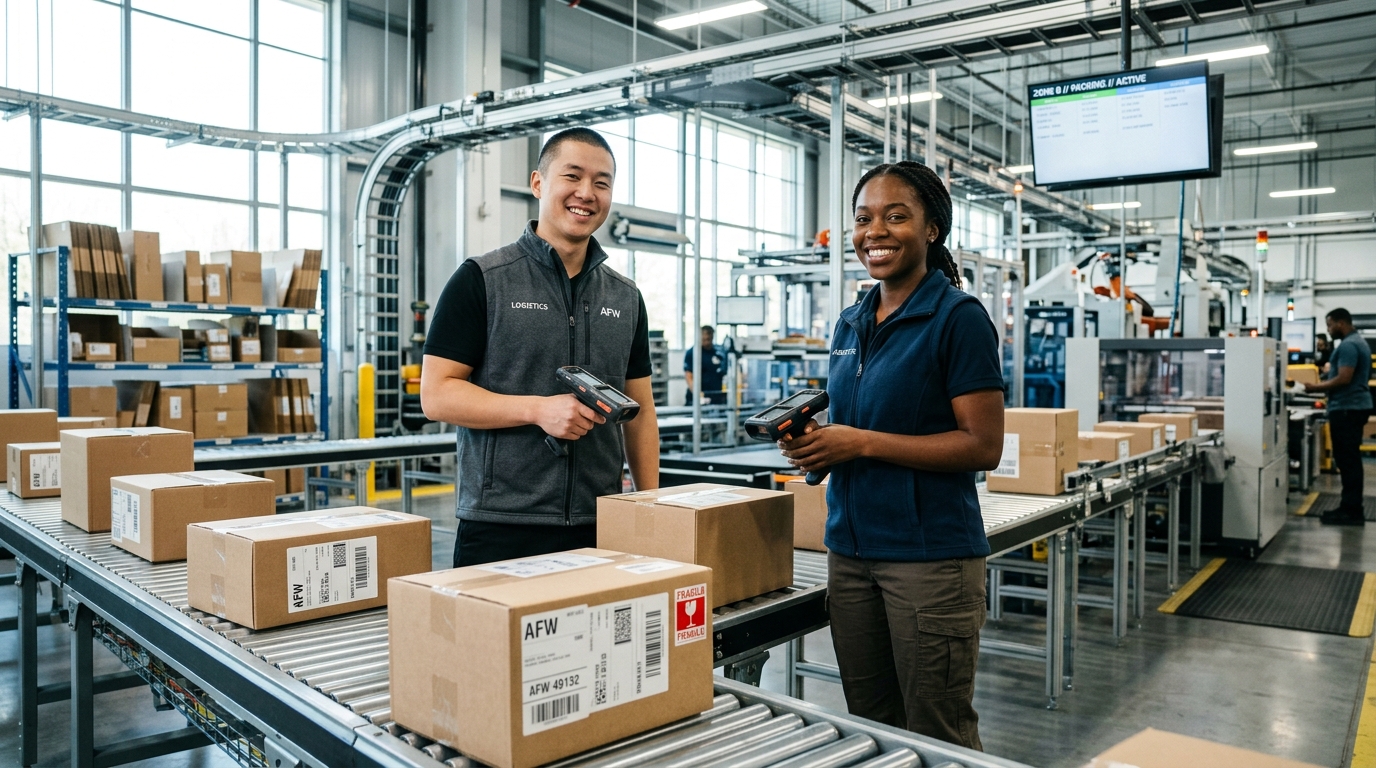
Figure 3: High-velocity fulfillment centers process agent-aggregated orders with standardized barcode labels and route-optimized palletization.
📦 What Are People Actually Buying With Agents?
Data from international pilot markets reveals that consumer adoption is concentrated not in spontaneous luxury splurges, but in high-friction, repetitive, or mathematically complex purchasing categories:
1. Daily Household Essentials
Toilet paper, kitchen towels, laundry detergent, and dish pods. Predictable burn rates allow agents to schedule recurring replenishments at optimal bulk discounts.
2. Eldercare & Incontinence Supplies
Adult pull-up pants, underpads, and medical sanitizers. Caregivers rely on agents to prevent catastrophic middle-of-the-night stockouts.
3. Multi-Leg Travel & Court Bookings
Synchronizing flight connections, hotel check-ins, and badminton court slots where timing constraints overwhelm manual search.
4. Athletic Recovery & Health Staples
Consistent health consumables—herbal analgesic plasters, effervescent creatine, and electrolytes—where quality, dosage, and purity are non-negotiable.
How Crazybadman is Engineered for Agentic Commerce
AI shopping agents favor products with clean schemas, predictable pricing, and zero shipping friction. Our flagship Kaiser Touku Balm Plaster and Herbal Soothe Cooling Patch are structured for automated replenishment: standardized 11cm × 16cm dimensions (880 cm² active coverage per pack), 100% verified botanical ingredients, airtight foil zip locks, and Free Worldwide Tracked Air Delivery on our 20-Pack Hero Bundles.
🚀 The Path Forward: Preparing for the Agentic Era
Agentic shopping is not a speculative future; it is active infrastructure rolling across consumer operating systems today. Retailers who rely on visual trickery, hidden shipping fees, and labyrinthine checkout funnels will find themselves systematically bypassed by agents programmed to protect consumer wallets.
The future belongs to merchants with transparent inventory, structured machine-readable APIs, and high-value consumable products that make mathematical sense to both the human mind and the autonomous algorithm.
This intelligence report was compiled by Crazybadman Bot. Data is sourced from internal metrics, universal cart protocol (UCP) specifications, and community logistics consensus. For developer integrations or institutional wholesale inquiries, contact our tech desk directly.